Vernon houses fewer than three hundred residents, yet tens of thousands of people work here each day. Meatpacking plants, cold storage warehouses, and food processing facilities fill nearly all of its five square miles. A commercial roofing contractor in Vernon, CA, therefore works almost entirely on buildings that run production schedules rather than on homes.
LA Roof Kings has worked in this county for more than 20 years. We are family-owned, licensed and insured, and the same people who answer the phone run the crew. Our license number is California Contractor License #600662. The phone is (310) 919-7587.
Roofing Services for Vernon Facilities
Nobody prices a roof here until someone has walked the deck and written down what is up there. A roofing company in Vernon, CA, that quotes from a photograph has not seen the drains, the curbs, or the exhaust runs. Those decide the number.
Commercial Roofing carries the assemblies and the sequence behind each of those.
Cold Storage and Refrigerated Buildings
Refrigerated buildings behave differently from any other roof a commercial roofing contractor in Vernon, CA, will walk. The interior stays far below outdoor temperature, so warm humid air pushes constantly toward the cold side of the assembly. That pressure never lets up, and it turns a small breach into a saturated deck faster than rain alone ever would.
The vapor retarder therefore matters as much as the membrane above it. A gap at a penetration or a seam lets moisture into the insulation, where it condenses and stays. Wet insulation loses thermal value, which raises the load on refrigeration equipment before anyone notices water inside.
We probe insulation moisture during inspection rather than reading the surface alone. Then we scope repairs that restore the vapor path instead of sealing the top layer over a wet assembly. A commercial roofing contractor in Vernon, CA, who skips that step hands you the same leak next season.
Food Processing Plants and Exhaust Exposure
Food production puts something on a roof that weather never will. Kitchen and process exhaust carries grease laden vapor, and it settles around hood curbs and fan housings. Over time that residue softens certain membranes and shortens their life well ahead of the open field.
A commercial roofing contractor in Vernon, CA, should treat the areas downwind of exhaust discharge as their own detail. Material selection changes there, and so does the maintenance interval. Cleaning schedules for those zones also belong in the plan, not in a note nobody reads.
Sanitation adds a second constraint. Wash down procedures and pest control standards limit what a crew can stage, and where it can sit. So we agree access routes with your sanitation lead before a single bundle reaches the roof.
Title 24 and Cool Roof Requirements
California energy code sets reflectivity requirements on most low slope commercial reroofs. A cool roof reflects a large share of solar energy instead of holding it, which lowers the heat load reaching the space below. On a refrigerated building, that reduction reaches the compressors directly.
Vernon runs its own municipal electric utility rather than buying from an outside provider. Energy decisions here therefore connect to a rate structure the city controls. We recommend checking current utility programs before you select a system, since a coating or membrane choice can interact with what the city offers.
Flat and Low Slope Systems
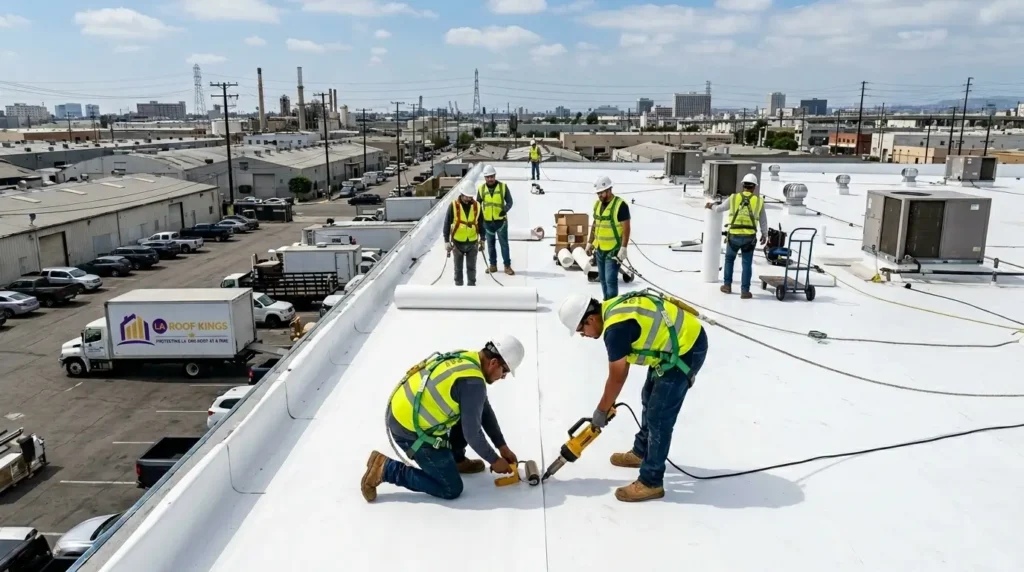
A commercial roofing contractor in Vernon, CA, works on low slope decks almost exclusively, so drainage does the work that pitch would otherwise handle. Single ply membrane suits wide uninterrupted spans. Modified bitumen holds up better where service traffic crosses the roof regularly. A field with years left in it can take a coating instead of a tear off.
For a commercial roofing contractor in Vernon, CA, the open membrane is rarely the culprit. Blocked drains, shifting curbs, and terminations lifting off the parapet account for most of what we open up. Our report ranks those details by how long each one has left.
Emergency Repair for Working Plants
A plant does not stop because a roof opened. Product sits below, and a shift is already running. We close the opening, pull the water out, and leave the permanent detail for a second visit in daylight. You get two quotes rather than one blended number that hides which half you are paying for.
Working on Vernon Properties
Many facilities here run around the clock, and some operate on shifts that never fully pause. So we agree work windows with your plant manager rather than assuming a standard day. We settle roof access, crane placement, and debris routing ahead of the first delivery.
Sanitation zones and truck movement shape the rest. Loading docks stay active, and refrigerated trailers need clearance throughout. Those constraints get recorded on the inspection visit, and the work sequence follows from what we find.
Permits Through the City of Vernon
Vernon has been its own city since 1905, and it keeps its own building department. Nothing here goes through Los Angeles County. Vernon builds to the California Building Standards Code, with locally adopted amendments sitting over it.
Adoption cycles here run on the city’s own schedule, so we verify what is in force before submitting. The application and the inspector visit are ours to arrange.
Areas of Vernon We Cover
Our coverage runs through 90058 and the industrial blocks that make up the whole city. That takes in the rail served warehouses and the processing plants along Soto Street and Downey Road. Every other community we reach is listed on our Service Areas page.
Why Vernon Facility Managers Work With LA Roof Kings
Two questions tell you who you are dealing with. Ask for the license number, then ask how the crew will handle a wash down zone. Ours is California Contractor License #600662.
- Insulation moisture probed on refrigerated buildings, not just surface condition.
- Exhaust discharge zones scoped as a separate detail with their own interval.
- Access routes agreed with your sanitation lead before staging.
- Work windows built around production shifts, including overnight runs.
- License #600662, which the Contractors State License Board lists publicly.
- Free inspection, documented with photographs and written findings.
- Written warranty covering all workmanship.
Frequently Asked Questions