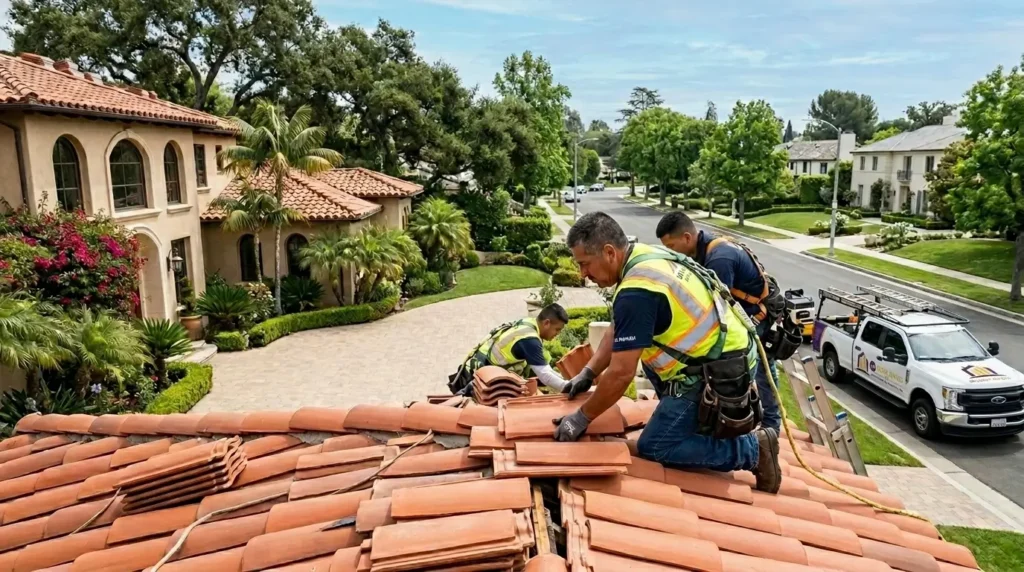
Homeowners here call a roofing contractor San Marino CA when a roof needs more than a patch, and LA Roof Kings takes those calls. Our family-owned crew has worked on local roofs for more than 20 years. Our work carries California Contractor License #600662. Every job starts with an inspection, not a sales pitch.
San Marino sets rules that most nearby cities do not. City code treats a roof replacement as a design matter, not only a building matter. That single difference decides how long your project runs. We plan around that difference from the first visit, so your permit does not stall at the counter. That approach carries across every one of our service areas in Los Angeles County.
Roof Replacement San Marino CA Starts With Design Review
Section 23.15.04 of the San Marino Municipal Code covers roof work directly. A roof replacement needs Design Review Committee approval unless the new roof matches the material, color, and application already on the house. Replacements that use materials from the City Council pre-approved list also skip that review.
Most homeowners want the second path. It keeps the job on a normal permit timeline instead of a committee calendar. The list runs long, but it stays specific. Each material carries its own color range, its own application rules, and its own limit on which house styles may use that material.
The Pre-Approved Roof Materials List
The current list came from Planning Commission Resolutions PCR 10-03 and PCR 24-05, amended in August 2024. It sets installation standards, not only product names. The city requires cut valleys rather than woven ones, and valley flashing goes in every time. Hip and ridge caps must sit low. Gutters have to screen the eave edges, and the list does not permit ninety degree edge rakes.
Some materials apply only to certain house styles. Spanish and Mediterranean homes draw from one part of the list. Tudor homes draw from another. Both point back to page references in the city’s Residential Design Guidelines. We match your house to the right section before we order anything. That step is routine work for a roofing contractor San Marino CA residents rely on.
When Your Project Goes to the Design Review Committee
Change the look of the roof and the committee reviews the project. They weigh four points. Fire, wind, and earthquake safety come first. Structural integrity follows. Then they look at how much of the roof the street and your neighbors can see. Last, they ask whether the material sheds rainwater properly on that specific house.
The building director can also send any roofing project to the committee. That happens most often on a front slope in full public view. We tell you up front which path your house falls under, so you can plan the schedule instead of guessing at it.
Tile Roof Repair San Marino CA Homes Depend On
Clay and concrete tile cover most San Marino roofs. Failures start under the tile, not on it. Cracked mortar at the ridge, slipped pieces after a wind event, and worn underlayment share one symptom. All three announce themselves as a stain on a ceiling. We lift, sort, and reset sound tile instead of replacing the whole field. Our tile roofing crew follows that order every time.
Matching a broken tile matters more here than in most cities. Color and profile both count toward the same or similar test in the code. Because of that, we source replacements that hold the match, so a small repair never turns into a design review case.
Tile Roof Replacement and Structural Load
Weight decides a great deal on a tile job. The city requires structural calculations for any roofing material over six pounds per square foot. Older San Marino framing does not always carry a heavier tile than the one it already holds. We check the existing assembly first, then tell you what the frame supports.
Slate Roof Repair San Marino CA Older Homes Require
Slate outlasts the fasteners and flashings around it. Those components fail first, and most slate problems start there. A slipped slate usually points to a corroded nail or a failed hook, not to a bad stone. Instead, we replace individual slates and rebuild the flashing detail. That keeps the original roof intact and keeps the color match exact.
Slate carries real weight, so the six pound rule applies to it directly. Any change from a lighter material to slate needs structural calculations before the city issues a permit. We run that check early instead of after you have chosen a product. Finding out late costs you time you did not budget for.
Roof Leak Repair San Marino CA and Underlayment Replacement
A leak on a tile or slate roof rarely sits under the stain. Water travels along the underlayment until it finds a break in the deck. A roofing contractor San Marino CA homeowners trust will trace that path instead of guessing at the entry point. Our roof leak repair process saves you from paying for the same repair twice.
Underlayment is the layer that does the waterproofing. It ages faster than the tile above it. When we pull a field and find brittle felt, we show you the section before we cover it back up. You decide whether to replace the run or the whole slope.
Flat Roof Repair San Marino CA on Additions and Garages
Plenty of San Marino homes carry a flat section over a rear addition, a porch, or a detached garage. Those areas fail first because water sits there instead of running off. That is why we check the drains, the parapet flashing, and the transition where the flat section meets the pitched roof above it.
Flat work on a visible structure still falls under the same design rules. A detached garage in public view carries no exemption. We treat it as part of the same submittal, so nothing holds up the permit later. Splitting the work into two applications only adds review time.
Gutter Installation San Marino CA and Skylight Repair
The pre-approved list requires gutters that screen the eave edges. That is a design requirement, not a drainage preference. We size and hang gutters that meet the rule and still carry the water your roof sheds during a heavy winter storm. Sizing them correctly belongs to any roofing contractor San Marino CA residents hire.
Skylights leak at the curb and the flashing, almost never through the glass. On a tile roof, the fix means pulling the surrounding field and rebuilding the flashing down to the deck. Afterward we reset the tile, so the repair never reads as a patch from the street.
Roof Inspection San Marino CA and Ongoing Maintenance
A roof inspection tells you what you have before you spend anything. We document condition slope by slope, note the underlayment age, and photograph what we find. You keep the report whether or not you hire us for the work.
Maintenance on a tile roof is mostly small work done on time. Reset the slipped pieces, clear the valleys, repoint the ridge, and check the flashings each year. Keeping that schedule holds an original roof in service far longer than waiting for failure. It is also the least disruptive work a roofing contractor San Marino CA owners call back will do all year.
Residential Roofing San Marino CA Backed by License #600662
We run a family-owned roofing company San Marino CA owners can reach directly, and the crew that quotes your roof does the work. Look up California Contractor License #600662 before you sign anything. Every completed job comes with a written warranty. We put the scope in writing before we start, including how we handle the design review step. See our full residential roofing services for what that covers.
If you own a commercial building here, our commercial roofing team handles those systems separately. Either way, one company handles the permit, the install, and the final inspection. That is what you should expect from a roofing contractor San Marino CA property owners recommend.
Frequently Asked Questions