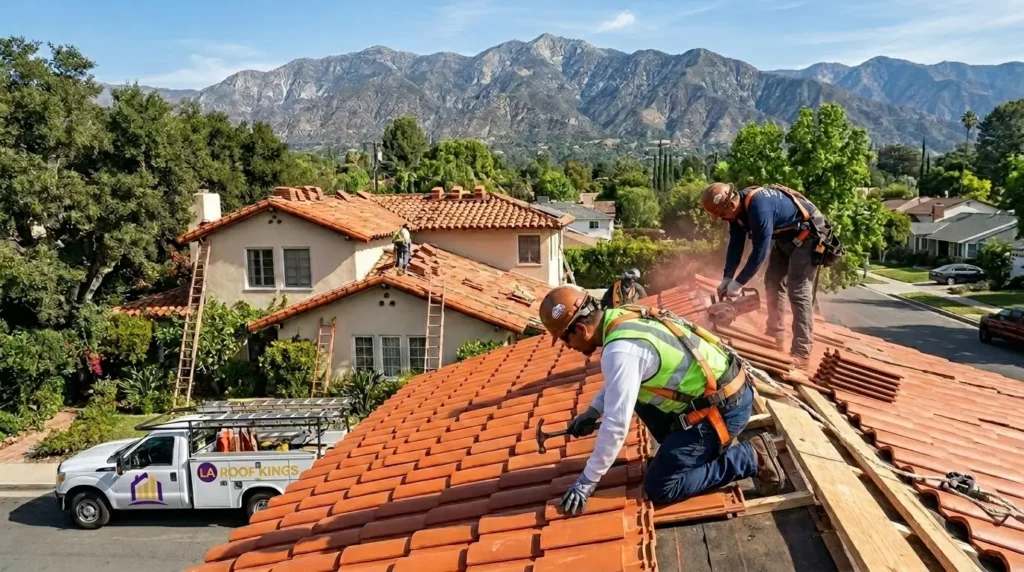
Sierra Madre writes its own rules for roof work, and those rules change depending on where your house sits. Outside the hillside zone, a reroof runs like any other permit. Inside the Hillside Management Zone, the same job can trigger a discretionary permit. A roofing contractor Sierra Madre CA owners hire should know which side of that boundary a property sits on.
LA Roof Kings is a family-owned company with more than 20 years on Los Angeles County roofs. California Contractor License #600662 covers every job we run. We start with an inspection and a written scope, never a number over the phone. Call (310) 919-7587. You will find this city listed with the rest on our Los Angeles County service areas page.
Re-Roofing Inside the Sierra Madre Hillside Management Zone
Chapter 17.52 of the Sierra Madre Municipal Code governs the R-H zone, which runs along the northern border of the city inside the lower foothills. The chapter requires a hillside development permit for most work on those lots. Section 17.52.060 lists the exceptions, and re-roofing is one of them.
The exemption comes with a condition. A reroof clears the permit requirement only when it uses the same color and the same type of materials as the existing roof. Match both and the job proceeds on a normal building permit. Change either one and you enter a different process entirely.
What a Color or Material Change Triggers
A hillside development permit runs through the same procedure as a conditional use permit under Chapter 17.60. The usual hearing notices apply. On top of those, the city mails notice to every record owner within one thousand feet of your property line. On a foothill street, that radius reaches well past your immediate neighbors.
An administrative hillside development permit is the lighter path, decided by the director rather than the planning commission. Even then, the director can refer any application up to the commission. So we check the exemption first on every hillside job. Clearing it saves you a hearing, so a roofing contractor Sierra Madre CA owners trust runs that check before quoting.
Roof Standards That Apply Inside the R-H Zone
Once a project needs approval under Chapter 17.52, the fire plan standards in Section 17.52.170 come with it. Roofs must use noncombustible materials. The color has to blend with the natural landscape. The code prohibits open eaves outright. An open eave lets birds nest and traps combustible material inside the roof area.
The design standards reach the roof shape too. Section 17.52.160 steers builders away from gable ends on downhill elevations. It also asks that the roof slope run in the same direction as the natural slope. Where two code provisions conflict on an R-H lot, the more restrictive one wins.
Roof Repair Sierra Madre CA Homes Need Most
Foothill exposure sets the repair list here. Wind funneling out of the canyons works at tile edges and loosens ridge caps. Grit washing off the slope settles in the channels and stays wet long after a storm passes. Afternoon sun hardens the sealant around vents and pipe collars. Our roof repair crew checks all three.
Replacement is the last option here, not the first. As long as the deck and underlayment still have life in them, we repair and leave the rest alone. Workmanship comes with a written warranty. On a hillside lot, we also confirm the exemption before touching the color of anything visible. Checking that is the mark of a roofing contractor Sierra Madre CA residents rely on.
Roof Replacement Sierra Madre CA and Underlayment Work
A roof replacement here raises a question that flatland cities never ask. Does the new roof match the old one? On an R-H lot, that single answer decides whether you file an ordinary building permit or a discretionary one. So we settle the material and the color before scoping anything else.
Often the roof does not have to change at all. When the covering still has life but the layer under it has gone brittle, an underlayment replacement fixes the actual failure. The original material goes back down, the color and type stay identical, and the exemption holds.
Tile Roof Replacement Sierra Madre CA Owners Ask About
Clay and concrete tile sit on a large share of the older houses here. Most tile failures start under the surface rather than on it. A slipped piece after a wind event, cracked mortar at the ridge, and brittle felt at the laps all read the same from inside. You see a damp patch on a ceiling.
Profile and color matter more here than in a flatland city. Both feed the color and material test written into the hillside code. So we photograph and measure the existing run before ordering anything, which is standard practice for any roofing contractor Sierra Madre CA homeowners hire. Our tile roofing work keeps the match exact wherever the original is still available.
Roof Leak Repair Sierra Madre CA Starts With Tracing the Source
A ceiling stain marks where water left the assembly, not where it got in. On a sloped lot that distance widens. Water follows the pitch until a fastener hole or a seam lets it drop. So we trace the source first and repair the failure point second. That order is the difference between a roofing contractor Sierra Madre CA property owners keep calling and one they replace.
Around here the entry point is usually a dammed valley, a ridge that lost its mortar, or a vent collar that dried out and split. Additions on older foothill houses add one more. The tie-in between the original roofline and the newer one rarely gets flashed the way it should.
Emergency Roof Repair Sierra Madre CA After a Storm
Canyon runoff changes the math on a foothill lot. Water that would spread out across a flat street arrives here in volume and carries grit with it. So the first call after a heavy storm is often about a valley that overflowed rather than a hole in the roof. We clear the blockage and dry the opening before diagnosing anything.
Access shapes response time too. Streets on the north side run narrow and steep in places, which limits where a truck can stage. We plan the approach when you call, not on arrival. Our emergency roof repair page covers the rest. Stabilize first, repair once the deck dries. Expect that order from a roofing contractor Sierra Madre CA owners call after a storm.
Fire Resistant Roofing Sierra Madre CA Hillside Lots Require
The noncombustible roofing requirement in Chapter 17.52 is a zoning rule, tied to the R-H zone and to approvals granted under that chapter. It sits alongside two related standards. Overhangs, including roofs, eaves, and balconies, must be noncombustible or protected by fire-retardant material. The code bars open eaves entirely.
That combination narrows the material list before anyone talks about appearance. We work through the zoning requirement, the color rule, and your budget in that order. Getting that sequence backward is how a homeowner settles on a product the city will not approve.
Roofers Sierra Madre CA Property Owners Can Verify
Check California Contractor License #600662 on the state register first. Verification is the floor, not a selling point, for any roofing contractor Sierra Madre CA owners consider. What actually separates crews is whether anyone climbed the roof before writing a number. Each system has its own page under residential roofing.
Sierra Madre runs a small commercial district rather than an industrial base. For a storefront or a mixed-use building, our commercial roofing team works low-slope systems on a separate track. The permit, the install, and the sign-off still run through one company.
Frequently Asked Questions